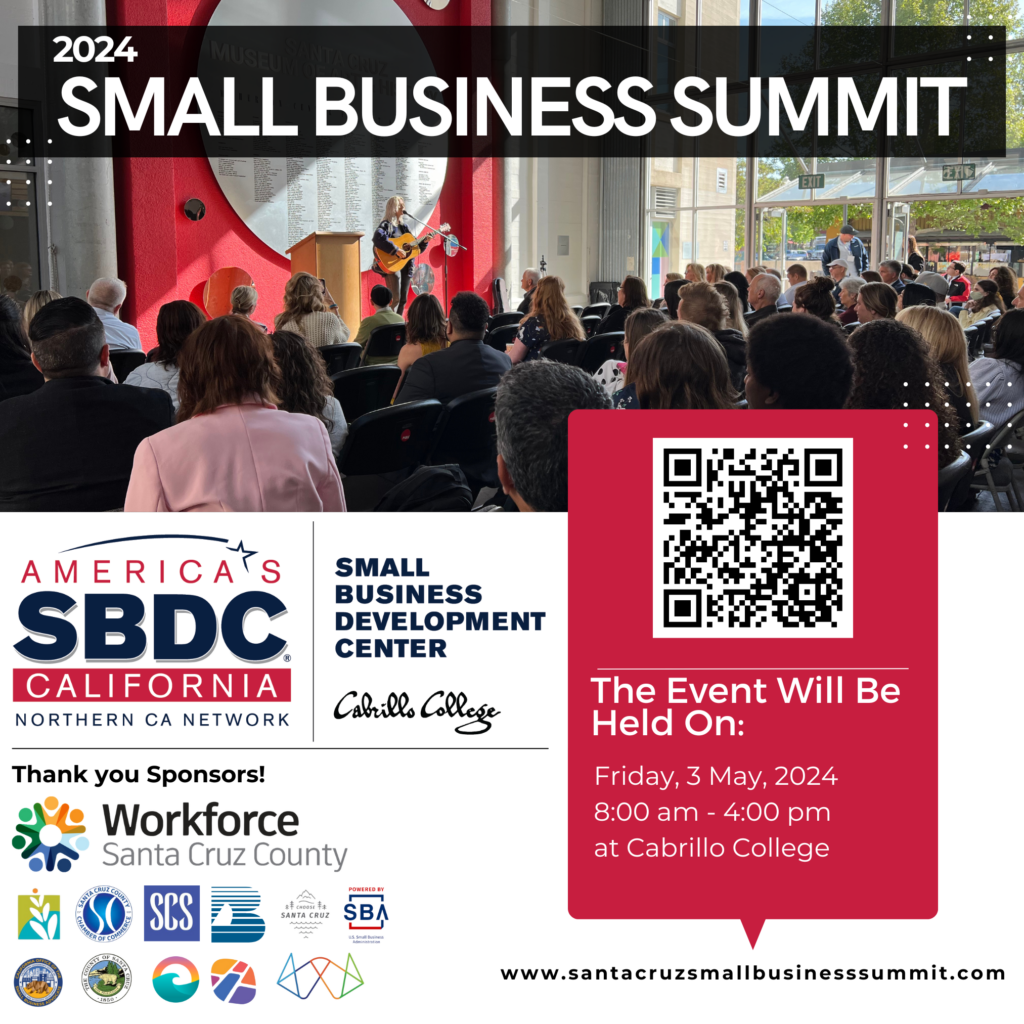
2024 Small Business Summit

May 3 8:00 am — 4:00 pm

Event Details

Experience the pulse of Santa Cruz County’s vibrant entrepreneurial scene at the highly anticipated Annual Small Business Summit on Friday, May 3rd, 2024. Presented by the Santa Cruz County Small Business Development Center (SBDC) at Cabrillo College, this exhilarating day-long conference unites over 200 local small business owners with the region’s most accomplished business professionals, innovative entrepreneurs, and industry trailblazers. This year’s summit featuring keynote speaker Guy Kawasaki alongside 13 captivating educational sessions, equips attendees with invaluable tools and resources, while nurturing networking opportunities among driven, like-minded individuals. Happening from 8 am to 4 pm, this year’s summit will be held at Cabrillo College’s Samper Recital Hall, with breakout sessions hosted across multiple campus locations.

How Free Bets Became a Standard Feature at Australian Bookmakers FreeBets Explains

The Australian sports betting market has undergone a profound transformation over the past two decades, shifting from a landscape dominated by TAB monopolies and trackside bookmakers to a fiercely competitive online environment where promotional offers have become central to how operators attract and retain customers. Among these promotions, the free bet — an offer that allows a punter to place a wager without risking their own funds — has emerged as perhaps the most recognisable and widely used tool in the industry. Understanding how free bets became embedded in Australian bookmaking culture requires looking at the regulatory shifts, the arrival of international operators, and the behavioural economics that made these offers so effective at driving customer acquisition. The story is not simply one of marketing innovation; it reflects deeper structural changes in how gambling is licensed, advertised, and consumed across the country.

The Regulatory Environment That Made Free Bets Possible

Australia’s betting industry is governed at the state and territory level, with each jurisdiction historically maintaining its own licensing framework. For much of the twentieth century, this meant that TAB corporations — statutory bodies established to manage off-course totalisator betting — held effective monopolies in most states. Private bookmakers operated on-course at racetracks but were generally prohibited from accepting bets remotely. The Interactive Gambling Act 2001 (IGA) was a landmark piece of federal legislation, but its primary focus was on prohibiting certain forms of online casino-style gambling rather than restricting sports betting. Crucially, the IGA permitted licensed Australian bookmakers to offer online sports and racing wagering services, which opened the door to the competitive online market that followed.

The Northern Territory emerged as the pivotal licensing jurisdiction. The NT’s relatively streamlined licensing process and lower tax rates on wagering turnover made it attractive to private operators, and from the mid-2000s onward, a growing number of bookmakers obtained NT licences and began offering online services nationally. Operators like Sportsbet, which was founded in Darwin in 1993 and later acquired by Paddy Power in 2011 before becoming part of Flutter Entertainment, used the NT framework to build national customer bases. Betfair, the UK-based betting exchange, entered the Australian market in 2005 after securing an NT licence, further disrupting the established order. By the late 2000s, the number of NT-licensed online bookmakers had grown substantially, and competition for customers had intensified to the point where promotional offers became a strategic necessity rather than an optional extra.

Free bets, in this context, were a direct product of competitive pressure. When a market has many suppliers offering functionally similar products — a bet on a horse race or a football match has the same underlying odds regardless of which platform you use — operators must differentiate on factors other than the product itself. Promotions, user experience, and customer service become the battleground. The free bet offer, borrowed in part from practices already established in the United Kingdom where the betting shop market had been deregulated since 1961, was adapted for the Australian online environment and quickly became a standard feature of new account sign-up packages.

How Free Bet Structures Evolved Over Time

Early free bet offers in the Australian market were relatively straightforward. A new customer would deposit a minimum amount, place a qualifying bet, and receive a free bet token of equivalent value, typically capped at around $50. The mechanics were simple enough that most punters could understand them without reading extensive terms and conditions. However, as competition intensified and operators sought to make their offers more attractive while managing liability, the structure of free bets became considerably more sophisticated.

One significant development was the introduction of turnover or rollover requirements, which stipulated that the winnings from a free bet had to be wagered a certain number of times before they could be withdrawn. This practice, common in casino bonus structures, was applied to sports betting promotions and drew criticism from consumer advocates who argued that the requirements made offers misleading. In response to growing scrutiny, some operators moved toward “bet and get” structures, where the free bet was awarded after the qualifying bet was settled, and the bonus funds themselves — rather than just the winnings — could be withdrawn after meeting conditions. Others introduced “money back” offers framed as free bets, where a losing first bet would be refunded as bonus funds rather than cash.

The Racing Australia and state racing bodies also played a role in shaping how free bets were used, particularly in relation to racing products. Agreements between bookmakers and racing authorities over product fees — the amounts operators pay for the right to use racing fields and data — affected the economics of promotions. When product fees increased, as they did following various negotiations throughout the 2010s, some operators adjusted their promotional budgets accordingly, leading to changes in the size and frequency of free bet offers.

Comparison and information resources tracking these offers became increasingly valuable to punters navigating a crowded market. The FreeBets website has documented how Australian bookmaker promotions have shifted over the years, reflecting the broader pattern of operators adjusting offer structures in response to both competitive pressure and regulatory guidance. This kind of third-party documentation is useful for understanding how the market has matured, since individual operator terms and conditions change frequently and historical records are not always easy to locate.

By the mid-2010s, the free bet landscape had fragmented into a range of distinct offer types. Matched deposit bonuses, where an operator would match a first deposit up to a certain amount in bonus funds, coexisted with fixed free bet tokens, odds boosts, and enhanced place terms on racing. The proliferation of offer types reflected both the creativity of marketing teams and the arms race dynamic that had developed: if one operator introduced a new promotion format that proved popular, competitors would typically follow within weeks. This pattern accelerated with the entry of international operators who brought experience from other regulated markets, particularly the UK, where promotional innovation had been occurring for longer.

The Impact of Advertising Restrictions and Responsible Gambling Measures

The visibility of free bet advertising in Australia reached its peak in the years between roughly 2012 and 2018, a period characterised by saturation-level marketing during live sports broadcasts. The ubiquity of betting advertisements — and specifically the prominence of promotional offers including free bets — generated significant public debate and political pressure. Research published by organisations including the Australian Gambling Research Centre documented the extent to which betting advertising had become embedded in sports coverage, with particular concern about exposure among children and problem gamblers.

The federal government’s response included a series of measures that directly affected how free bets could be advertised. The National Consumer Protection Framework (NCPF) for online wagering, which was developed through a Council of Australian Governments process and began to be implemented from 2019 onward, introduced a range of requirements that operators had to meet. Among the most significant for free bet promotions was the restriction on inducements to gamble. Under the NCPF, operators were prohibited from offering free bets or other inducements to customers who had not yet signed up, or from using inducements as a primary mechanism for encouraging existing customers to increase their betting activity. The framework also introduced requirements around self-exclusion, pre-commitment tools, and responsible gambling messaging.

The Broadcasting Services Amendment (Online Safety) Act and subsequent changes to the Broadcasting Services Act placed additional restrictions on when and how betting advertisements could appear during live sports broadcasts. The prohibition on gambling advertisements during live sport from five minutes before the start until five minutes after the end of play — with exceptions for racing — significantly reduced the visibility of free bet promotions during the periods when they had previously been most prominent. Operators adapted by shifting promotional activity toward digital channels, email marketing to existing customers, and social media platforms, where the regulatory environment was somewhat different and enforcement more complex.

State-level restrictions added further complexity. Victoria, for example, introduced its own advertising restrictions through the Victorian Commission for Gambling and Liquor Regulation (VCGLR), and Western Australia maintained its distinct regulatory posture through the Racing and Gaming division. The patchwork of state and federal rules meant that operators running national campaigns had to navigate multiple compliance requirements simultaneously, which increased the administrative cost of promotional activity and, in some cases, led to a rationalisation of offer types. Simpler, more clearly structured free bet offers became preferable to complex multi-stage promotions that were harder to communicate within restricted advertising formats.

FreeBets, as a resource tracking these developments, has noted that the post-NCPF period saw a consolidation of offer types among major operators, with the most common structure being a straightforward matched first-bet offer capped at a specific dollar amount, accompanied by clear terms about minimum odds and withdrawal conditions. This standardisation reflects the influence of regulatory guidance on promotional design: when advertising is restricted and compliance requirements are stringent, operators tend toward formats that are easiest to explain and defend.

The Economics of Free Bets and Their Role in Customer Lifetime Value

From an operator’s perspective, the free bet is not a charitable gesture but a calculated investment in customer acquisition. The economics of sports betting promotions are governed by the concept of customer lifetime value — the total net revenue an operator expects to generate from a customer over the duration of their relationship. If the expected lifetime value of a new customer exceeds the cost of acquiring them, including the cost of any promotional offer, then the promotion is economically rational. The challenge is that lifetime value varies enormously between customers, and operators have historically had limited ability to predict at the point of acquisition which new customers will be high-value and which will take the free bet and never return.

Academic research into the behavioural economics of gambling promotions has found that free bets function partly as a form of experiential marketing: they allow potential customers to engage with a platform without the psychological barrier of risking their own money, which can accelerate the process of habit formation. A 2017 study published in the International Gambling Studies journal examined the relationship between promotional offers and gambling intensity, finding that customers who received free bets in their first month of registration tended to place more bets and deposit more frequently in subsequent months than those who did not receive such offers. While the causal direction of this relationship is difficult to establish definitively — it may be that more engaged customers are also more likely to redeem offers — the correlation is consistent with the hypothesis that free bets contribute to customer retention as well as acquisition.

The cost of a free bet to an operator is not simply its face value. When an operator awards a $50 free bet, the expected cost depends on the odds of the bet placed and the margin built into those odds. If a customer places a $50 free bet on a market where the operator holds a 5% margin, the expected cost to the operator is approximately $47.50 — the $50 payout probability adjusted for the margin. In practice, customers often place free bets on higher-odds selections, which reduces the expected cost further but increases variance. Operators manage this variance through bet limits, restrictions on the odds at which free bets can be placed, and by running promotions at scale so that individual outcomes average out.

The competitive dynamic among Australian operators has also been influenced by the financial resources of their parent companies. Sportsbet’s backing from Flutter Entertainment, Ladbrokes and Neds operating under the Entain umbrella, and TAB’s various ownership structures over the years have meant that promotional budgets are partly determined by decisions made in London and Dublin as much as in Sydney or Melbourne. International parent companies with experience in multiple regulated markets have been able to deploy promotional strategies refined elsewhere, giving them an advantage over purely domestic operators in terms of the sophistication of their acquisition models.

The introduction of betting exchanges and corporate bookmakers offering best-taker pricing also affected the economics of free bets. When customers can compare odds across platforms easily — and when third-party comparison tools make this comparison even simpler — the value of a free bet becomes a more significant differentiator. A $50 free bet at an operator with consistently competitive odds is worth more to a punter than the same offer at an operator with poorer pricing, which has driven some operators to combine free bet promotions with best-odds guarantees or price-matching commitments.

The maturation of the Australian online betting market has brought the free bet to a point of near-ubiquity. Almost every licensed operator offering online sports and racing wagering in Australia includes some form of welcome promotion for new customers, and the free bet — in one of its various structural forms — remains the most common vehicle for this offer. The path from the early competitive skirmishes of the mid-2000s to the regulated, structured promotional environment of the 2020s reflects the broader arc of the industry’s development: an initial period of rapid growth and experimentation, followed by regulatory intervention, market consolidation, and a gradual professionalisation of promotional practices. For punters, the result is a market where free bets are readily available but increasingly standardised; for operators, they remain an essential tool in a competitive landscape that shows no sign of becoming less crowded. The challenge for both sides is navigating an environment where the rules continue to evolve and where the long-term sustainability of promotional spending remains a subject of ongoing debate within the industry.

Register today!

The information provided in this training and any supplementary materials provided to registrants are intended for educational and informational purposes only and does not constitute professional financial or legal advice. No registrant should act or fail to act on the basis of any material contained in this webinar without obtaining proper financial, legal or other professional advice specific to their situation. The Northern California Small Business Development Center, and its host, the HSU Sponsored Programs Foundation, specifically disclaims any liability, loss or risk, personal or otherwise, which is incurred as a consequence, directly or indirectly, of the use and application of any of the information presented in this webinar. By registering for this webinar you acknowledge and agree that you have read, understood, accept and agree to the above disclaimer and that under no circumstances shall the Northern California Small Business Development Center or it’s host, the HSU Sponsored Programs Foundation, be held liable for any claims, losses, or damages of any kind or nature arising out of or in any way related to the information provided in this webinar and/or the registrant’s use of or reliance on said information.